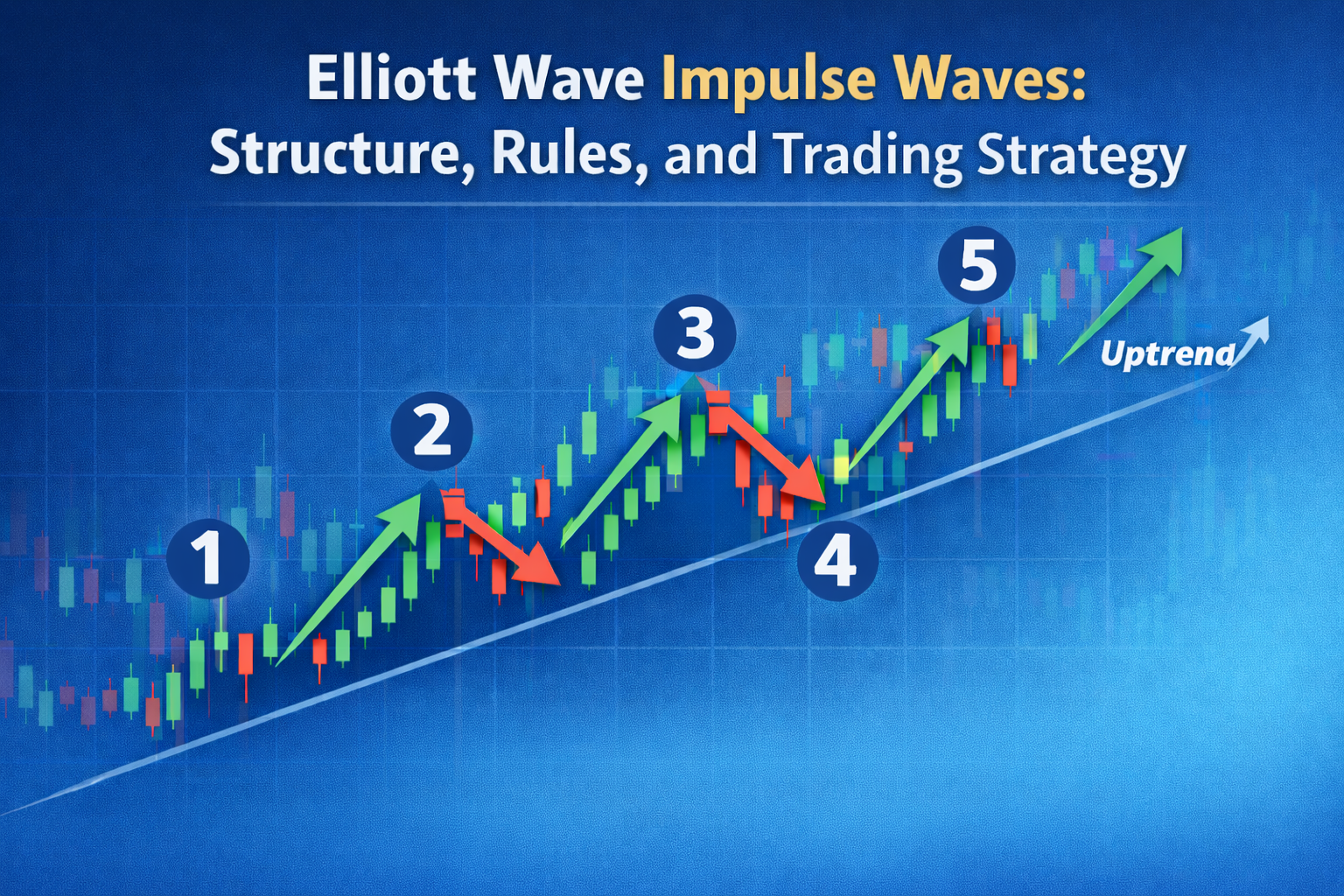
 Impulse waves are one of the most important concepts in Elliott Wave Theory. They represent strong directional price movements and help traders identify the dominant trend in financial markets.
Understanding impulse waves allows traders to recognize market momentum, identify trend continuation patterns, and locate potential entry points.
What Are Elliott Wave Impulse Waves?
An impulse wave is a five-wave pattern that moves in the direction of the primary market trend.
The impulse structure follows this sequence:
Wave 1 → Wave 2 → Wave 3 → Wave 4 → Wave 5
- Waves 1, 3, and 5 move in the direction of the trend.
- Waves 2 and 4 are corrective waves that temporarily move against the trend.
Impulse waves appear in both bullish and bearish markets and form the foundation of trend movement in Elliott Wave analysis.
The Three Rules of Elliott Wave Impulse Waves
Impulse waves must follow three strict rules:
Rule 1: Wave 2 Cannot Retrace More Than Wave 1
Wave 2 must never move beyond the starting point of Wave 1.
Rule 2: Wave 3 Cannot Be the Shortest Wave
Among Waves 1, 3, and 5, Wave 3 can never be the shortest wave. In many markets, Wave 3 is usually the strongest and longest wave.
Rule 3: Wave 4 Cannot Overlap Wave 1
Wave 4 must stay outside the price territory of Wave 1.
If any of these rules are broken, the pattern is not a valid impulse wave.
Traders often combine impulse wave analysis with Fibonacci retracement and Fibonacci extension levels to identify potential support, resistance, and wave targets.

Structure of an Elliott Wave Impulse
Impulse waves contain five internal subdivisions.
These smaller waves are typically labeled:
((i)) – ((ii)) – ((iii)) – ((iv)) – ((v))
This structure reflects the fractal nature of financial markets, where smaller waves combine to form larger waves across different timeframes.
Key characteristics include:
- strong directional momentum
- clear five-wave structure
- increasing trend strength
- possible divergence in Wave 5
Understanding impulse waves becomes easier when combined with knowledge of other common trading patterns used in technical analysis.
Key Characteristics of Impulse Waves
Impulse waves typically show several recognizable features.
Strong Trend Momentum
Impulse waves move strongly in the direction of the dominant trend.
Five-Wave Structure
The pattern clearly forms a five-wave trend structure.
Wave 3 Strength
Wave 3 usually displays the strongest momentum and highest trading activity.
Divergence in Wave 5
Wave 5 frequently ends with momentum divergence, which may signal trend exhaustion. Understanding Elliott Wave structures is easier when combined with some of the most effective forex trading indicators used in technical analysis.
Extensions in Impulse Waves
Most impulse waves contain extensions, where one motive wave becomes significantly longer.
Common extension types include:
- Wave 1 Extension
- Wave 3 Extension
- Wave 5 Extension
In most financial markets, Wave 3 is the most commonly extended wave. Many traders use the Relative Strength Index (RSI) alongside Elliott Wave structures to identify overbought or oversold market conditions.
When an extension occurs, the impulse may display nine visible subwaves rather than the typical five.
Even with additional subdivisions, the overall structure remains technically the same.
Truncation in Impulse Waves
A truncated fifth wave occurs when Wave 5 fails to move beyond the end of Wave 3.
This situation often happens after a very strong Wave 3, where the market loses momentum before completing the final impulse.
Truncations often signal:
- weakening trends
- possible market reversals
- exhaustion of buying or selling pressure
Traders who want real-time Elliott Wave analysis and professional forecasts can explore our subscription plans to access daily market updates and trading strategies.
The Principle of Alternation
The principle of alternation is an important guideline in Elliott Wave analysis.
It suggests that corrective waves tend to alternate in structure.
For example:
- If Wave 2 is a sharp correction, Wave 4 will likely be sideways.
- If Wave 2 is sideways, Wave 4 may be sharp.
Common corrective structures include:
- zigzags
- flats
- triangles
- double or triple corrections
Understanding alternation helps traders anticipate future market behavior. Combining Elliott Wave analysis with forex signals can help traders improve timing when entering or exiting trades.
How to Trade Impulse Waves
Impulse waves offer several trading opportunities.
Trading the End of Wave 2
Many traders enter the market near the completion of Wave 2 because the next impulse wave may begin.
Typical setup:
Entry: Near the end of Wave 2
Stop loss: Below the beginning of Wave 1
This strategy attempts to capture Wave 3, which often produces the strongest movement. Traders who want to improve their market analysis skills can also explore some of the best trading courses that teach advanced technical analysis and Elliott Wave strategies.
Trading the End of Wave 4
Another opportunity appears near the completion of Wave 4.
Wave 4 corrections often follow the alternation principle, allowing traders to anticipate the corrective pattern.
Typical setup:
Entry: Near Wave 4 completion
Stop loss: Below the Wave 1 level
If Wave 4 overlaps Wave 1, the impulse structure becomes invalid.
Types of Impulse Wave Extensions
Three types of extensions may occur within impulse structures.
Wave 1 Extension
Wave 1 becomes the longest wave in the structure.
Wave 3 Extension
This is the most common type of extension.
Wave 5 Extension
Wave 5 becomes the longest wave and often appears near the end of strong trends.
Recognizing these extension patterns helps traders interpret market strength.
Conclusion
Impulse waves are one of the most powerful tools within Elliott Wave analysis. They explain how markets move in strong directional trends and provide traders with insight into market structure.
While Elliott Wave analysis cannot predict markets with certainty, it provides a framework for evaluating probable price movements. Many traders apply impulse wave analysis when following gold trading signals to anticipate strong market trends.
By understanding impulse wave structure, traders can better identify trends, manage risk, and locate high-probability trading opportunities.
Frequently Asked Questions (FAQ)
What is an impulse wave in Elliott Wave theory?
An impulse wave is a five-wave pattern that moves in the direction of the main market trend.
Which wave is usually the strongest?
Wave 3 is typically the strongest and longest wave in the structure.
Can Wave 3 be the shortest wave?
No. According to Elliott Wave rules, Wave 3 can never be the shortest among Waves 1, 3, and 5.
When do traders usually enter impulse wave trades?
Common entry points occur near the completion of Wave 2 or Wave 4, anticipating the next impulse movement.