
Leading and ending diagonals are motive wave patterns in Elliott Wave Theory, but unlike standard impulse waves, they follow a unique structure. One key feature is that wave 4 overlaps wave 1, which is rare in typical impulse waves
These diagonal patterns appear at specific points in a trend:
- Leading diagonal → Start of a trend
- Ending diagonal → End of a trend
Leading Diagonal
A leading diagonal forms at the beginning of a new trend, typically in wave 1 or wave A
Key Features
- Structure: 5-3-5-3-5
- Appears in early trend stages
- Can be contracting or expanding
- Indicates trend continuation after correction
Rules of Leading Diagonal
- Wave 4 overlaps wave 1
- Wave 3 cannot be the shortest
- Wave 2 retraces 61.8%–99% of wave 1
- Wave 2 must not break the origin of wave 1
- Wave 4 must not break the origin of wave 3
Trading Insight
After a leading diagonal completes, expect a deep retracement, followed by continuation of the main trend.
Ending Diagonal
An ending diagonal appears at the end of a trend (wave 5) and signals trend exhaustion and potential reversal
Key Features
- Structure: 3-3-3-3-3
- All waves are corrective
- Forms wedge-like pattern
- Strong signal of market reversal
Rules of Ending Diagonal
- Wave 1 overlaps wave 4
- Wave 3 cannot be the shortest
- All sub-waves are corrective
- Momentum divergence often appears (e.g., RSI)
Trading Insight
Ending diagonals often lead to sharp reversals, making them powerful signals for entry in the opposite direction.
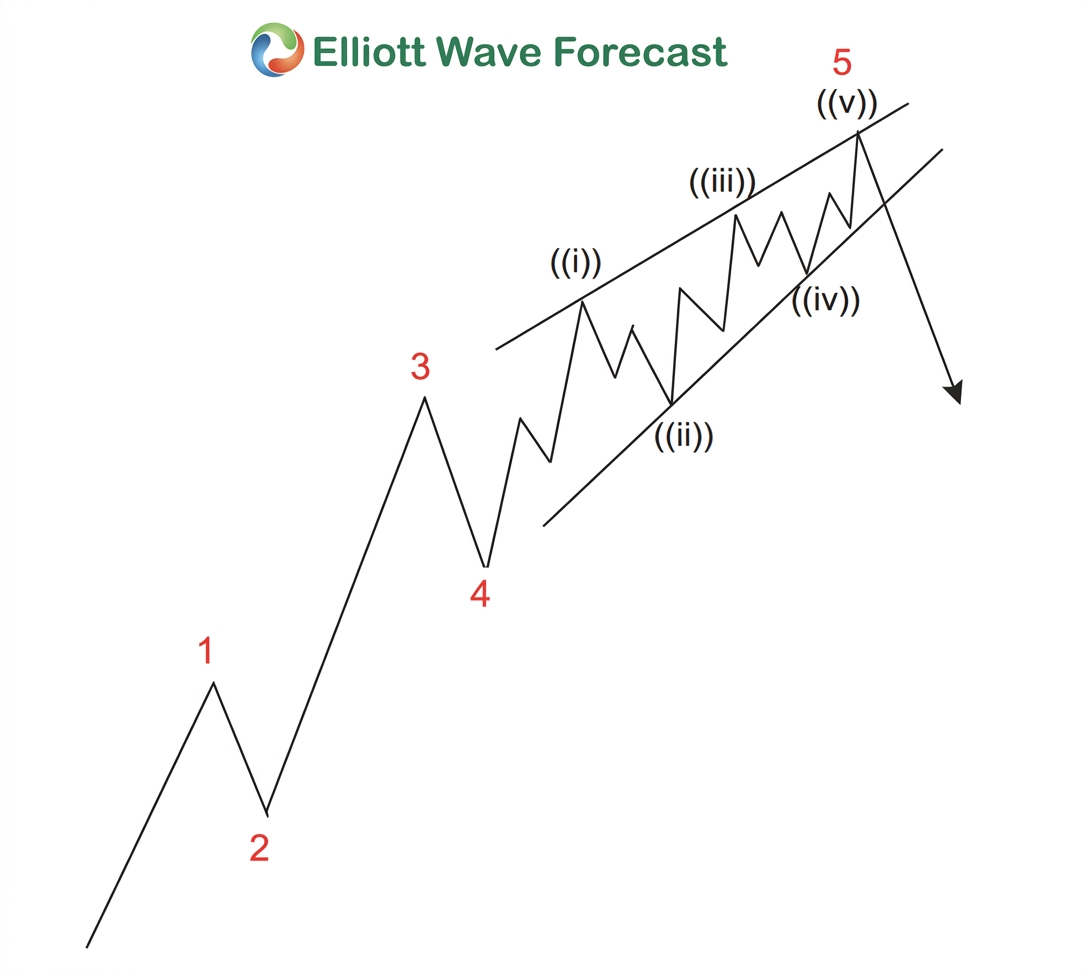 Leading vs Ending Diagonal (Quick Comparison)
| Feature | Leading Diagonal | Ending Diagonal |
|---|---|---|
| Position | Start of trend | End of trend |
| Structure | 5-3-5-3-5 | 3-3-3-3-3 |
| Signal | Continuation | Reversal |
| Market Phase | Early trend | Trend exhaustion |

Trading Strategy for Diagonal Patterns
Step 1: Identify the Pattern
- Analyze charts carefully
- Confirm wave structure matches diagonal rules
Step 2: Confirm Trend
- Leading diagonal → trend beginning
- Ending diagonal → trend ending
Step 3: Entry Points
- Leading diagonal: Enter after retracement
- Ending diagonal: Enter after reversal confirmation
Step 4: Risk Management
- Place stop-loss:
- Start of leading diagonal
- End of ending diagonal
Step 5: Target Levels
- Wave 3 ≈ 161% of wave 1
Step 6: Use Indicators
- RSI divergence
- Support & resistance
- Fibonacci retracement
Pro Tips for Traders
- Always confirm diagonal patterns with multiple indicators
- Avoid entering trades without clear wave structure
- Ending diagonals often bring high volatility
- Look for wedge patterns + divergence for strong signals
Conclusion
- Leading diagonals signal the start of a new trend
- Ending diagonals signal the end of a trend and possible reversal
- Both patterns are powerful tools when used with proper confirmation
Mastering these patterns can significantly improve your Elliott Wave trading accuracy and timing.