 Forex trading is one of the most dynamic and liquid markets in the world. Every day, trillions of dollars change hands as traders, institutions, hedge funds, and central banks participate in the global currency market. Despite the enormous opportunities available, many traders struggle with one critical challenge: understanding where the market is likely to move next.
Most trading strategies focus on reacting to price action after it happens. Elliott Wave Theory takes a different approach. Instead of simply identifying what the market has already done, it attempts to forecast what the market is most likely to do next by understanding recurring elliott wave patterns driven by crowd psychology.
For decades, professional traders have used Elliott Wave analysis to identify trends, anticipate corrections, and discover high-probability trading opportunities. When combined with proper risk management and Fibonacci analysis, Elliott Wave Theory can provide traders with a complete framework for navigating the Forex market.
In this guide, we will explore how to trade Forex using Elliott Wave Theory, how wave structures develop, how to identify trading opportunities, and how professional analysis from Elliott Wave Forecast can help traders gain a deeper understanding of market behavior.
What Is Elliott Wave Theory?
Elliott Wave Theory was developed by Ralph Nelson Elliott in the 1930s after observing that financial markets move in repetitive cycles. Elliott discovered that market movements are not random. Instead, they are heavily influenced by investor sentiment and crowd psychology.
According to Elliott Wave Theory, markets move in two primary phases:
The first phase is the impulsive phase, which follows the direction of the larger trend. This phase consists of five waves labeled 1, 2, 3, 4, and 5.
The second phase is the corrective phase, which moves against the dominant trend and consists of three waves labeled A, B, and C.
Together, these eight waves form a complete market cycle.
One of the most fascinating aspects of Elliott Wave Theory is its fractal nature. Wave structures appear across every timeframe, from monthly charts to intraday trading charts. A five-wave move on a one-hour chart may simply represent a smaller component of a larger wave structure visible on the daily chart.
This characteristic makes Elliott Wave Theory highly adaptable for both swing traders and short-term Forex traders.
Why Elliott Wave Works So Well in Forex Markets
Currency markets are driven by expectations, fear, greed, optimism, and uncertainty. Economic reports, interest rate decisions, geopolitical developments, and central bank policies all influence trader behavior.
Since Elliott Wave Theory is fundamentally based on crowd psychology, it naturally aligns with the forces that drive Forex markets.
Rather than relying solely on lagging indicators, Elliott Wave analysis allows traders to understand market structure and identify where price may be positioned within a larger cycle.
This helps traders:
- Identify the dominant trend
- Anticipate corrections before they happen
- Locate high-probability entry zones
- Project future price targets
- Improve risk management
- Avoid chasing emotional market moves
At Elliott Wave Forecast, this principle forms the foundation of our daily market analysis. Our analysts monitor Forex pairs, commodities, indices, stocks, ETFs, and cryptocurrencies using Elliott Wave structures and Fibonacci relationships to identify opportunities before they fully develop.
Understanding the Five-Wave Impulse Structure
To successfully trade Forex using Elliott Wave Theory, traders must first understand the five-wave impulsive pattern.
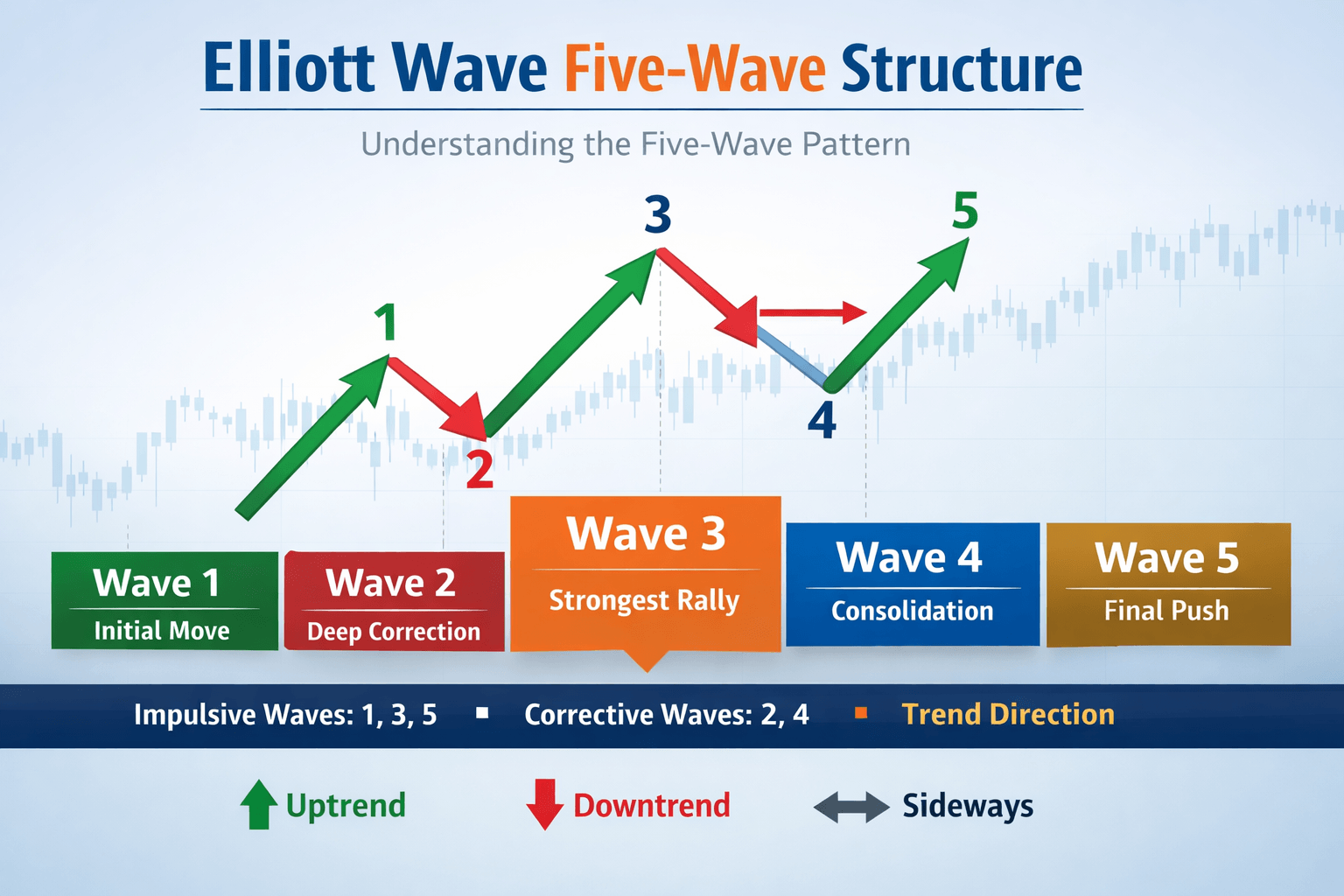
Wave 1: The Birth of a New Trend
Wave 1 often begins quietly. The previous trend is still fresh in everyone’s mind, and most traders remain convinced that it will continue.
Imagine EUR/USD has been declining for several weeks. Suddenly, the pair begins to rally. At this stage, most market participants view the move as nothing more than a temporary bounce.
This skepticism is exactly what makes Wave 1 difficult to identify.
Volume may increase slightly, but confidence in the new trend remains limited.
Wave 2: The Test of Conviction
Wave 2 retraces part of Wave 1 and often creates doubt among traders who entered early.
Many traders assume the prior trend is returning and exit their positions prematurely.
However, a valid Wave 2 cannot retrace beyond the starting point of Wave 1.
Most Wave 2 corrections retrace between 50% and 61.8% of Wave 1, creating potential buying opportunities.
Professional traders often pay close attention to these retracement zones because they frequently offer attractive risk-to-reward setups before the strongest phase of the trend begins.
Wave 3: The Opportunity Wave
Wave 3 is often considered the most profitable wave in Elliott Wave trading.
This is where momentum accelerates and the broader market begins recognizing the emerging trend.
Economic news starts supporting the move, analysts revise forecasts, and traders who missed the initial rally attempt to enter.
Wave 3 frequently extends to 161.8% of Wave 1 and can become significantly larger.
Many of the Forex trade setups published by Elliott Wave Forecast focus on identifying opportunities during Wave 3 because these moves often offer the greatest profit potential with relatively low risk.
Wave 4: The Consolidation Phase
After the powerful move of Wave 3, the market typically enters a period of consolidation.
Wave 4 often moves sideways rather than sharply lower.
This phase can be frustrating because price appears directionless. However, experienced Elliott Wave traders understand that this pause often prepares the market for one final move in the trend direction.
Wave 4 generally retraces less than 38.2% of Wave 3 and frequently develops through complex corrective patterns.
Recognizing these consolidations can help traders avoid exiting winning trades prematurely.
Wave 5: The Final Push
Wave 5 represents the last stage of the impulsive sequence.
By this point, the trend has become widely accepted. Financial media coverage increases, sentiment becomes extremely optimistic, and retail participation often reaches its highest levels.
Ironically, this is often when professional traders begin preparing for a reversal.
Momentum indicators frequently display bearish divergence during Wave 5, suggesting that buying pressure is weakening even as prices continue making new highs.
Understanding this behavior allows traders to protect profits and prepare for the corrective phase that follows.
Understanding Corrective Waves in Forex Trading
Once the five-wave sequence is complete, the market enters a correction.
Corrective patterns consist of three waves labeled A, B, and C.
Wave A often catches traders by surprise because most participants still believe the dominant trend remains intact.
Wave B creates even more confusion because it temporarily resumes the previous trend, convincing many traders that the correction has ended.
Wave C is usually the strongest part of the correction. By the time it unfolds, most market participants finally recognize that the market has entered a broader retracement phase.
Understanding corrective structures is crucial because many traders lose money by entering positions near the end of Wave B, only to be caught in the powerful Wave C decline.
Forex traders who can identify these corrective phases gain a significant advantage in both timing and risk management.
Using Fibonacci Ratios in Elliott Wave Forex Trading
One of the reasons Elliott Wave Theory remains popular among professional traders is its close relationship with Fibonacci mathematics. While Elliott Wave helps traders understand market structure, Fibonacci ratios help identify where waves are likely to end and where the next move may begin.
In Forex trading, Fibonacci retracements and extensions are frequently used to estimate support zones, resistance levels, and profit targets. Wave 2 commonly retraces between 50% and 61.8% of Wave 1, while Wave 3 often extends to 161.8% of Wave 1. Wave 4 corrections frequently retrace around 38.2% of Wave 3, and Wave 5 often reaches equality with Wave 1 or extends further depending on market momentum.
These relationships are not guaranteed, but they provide traders with objective areas to monitor. Instead of entering trades randomly, traders can use Fibonacci levels to identify locations where the market is more likely to react.
At Elliott Wave Forecast, Fibonacci extensions and retracements play a central role in our daily market analysis. Every trade setup is supported by clear Fibonacci relationships, helping traders understand not only where a move could go, but also where it could fail.
A Practical Forex Trading Example Using Elliott Wave
Understanding the theory is important, but seeing how it works in a real trading scenario helps bring everything together.
Imagine EUR/USD has been declining for several weeks before finally finding support and beginning a small rally. This initial move higher forms what appears to be Wave 1.
Rather than chasing the rally, an Elliott Wave trader waits patiently for Wave 2 to develop. The correction retraces approximately 61.8% of Wave 1 and begins showing signs of stabilization near a key support zone.
At this point, the trader has several pieces of evidence supporting a bullish trade idea:
The market has completed a potential Wave 1. The correction has retraced into a common Fibonacci support area. Momentum indicators are beginning to turn higher. Risk can be clearly defined below the Wave 1 low.
A long position is initiated near the completion of Wave 2.
As the market begins advancing into Wave 3, momentum accelerates significantly. Economic news starts supporting the move, and traders who initially doubted the trend begin entering the market.
The position eventually reaches a Fibonacci extension target near 161.8% of Wave 1, generating a favorable risk-to-reward outcome.
This type of structured approach removes much of the emotional decision-making that causes traders to enter too early, exit too soon, or chase extended moves.
Understanding Blue Box Trading Opportunities
One of the unique concepts used by Elliott Wave Forecast is the Blue Box trading area.
A Blue Box represents a high-probability reaction zone generated through a combination of Elliott Wave structure and Fibonacci measurements. Rather than predicting exact turning points, the Blue Box identifies areas where buyers or sellers are expected to appear.
This approach recognizes an important reality about trading: markets rarely reverse at a single price level. Instead, they tend to react within areas of support and resistance.
When price enters a Blue Box area, traders can monitor price behavior for signs of a reaction. These setups often provide favorable risk-to-reward opportunities because they allow traders to participate near potential turning points while maintaining clearly defined risk.
Blue Box setups are regularly published across Forex, Stocks, Commodities, Cryptocurrencies, and Indices, providing members with practical trade opportunities based on real-time market conditions.
Best Forex Pairs for Elliott Wave Trading
Although Elliott Wave Theory can be applied to any currency pair, some markets tend to produce cleaner wave structures than others.
EUR/USD is often considered one of the best pairs for Elliott Wave analysis due to its exceptional liquidity and relatively smooth price action. The pair frequently develops clear impulsive and corrective structures, making wave counts easier to identify.
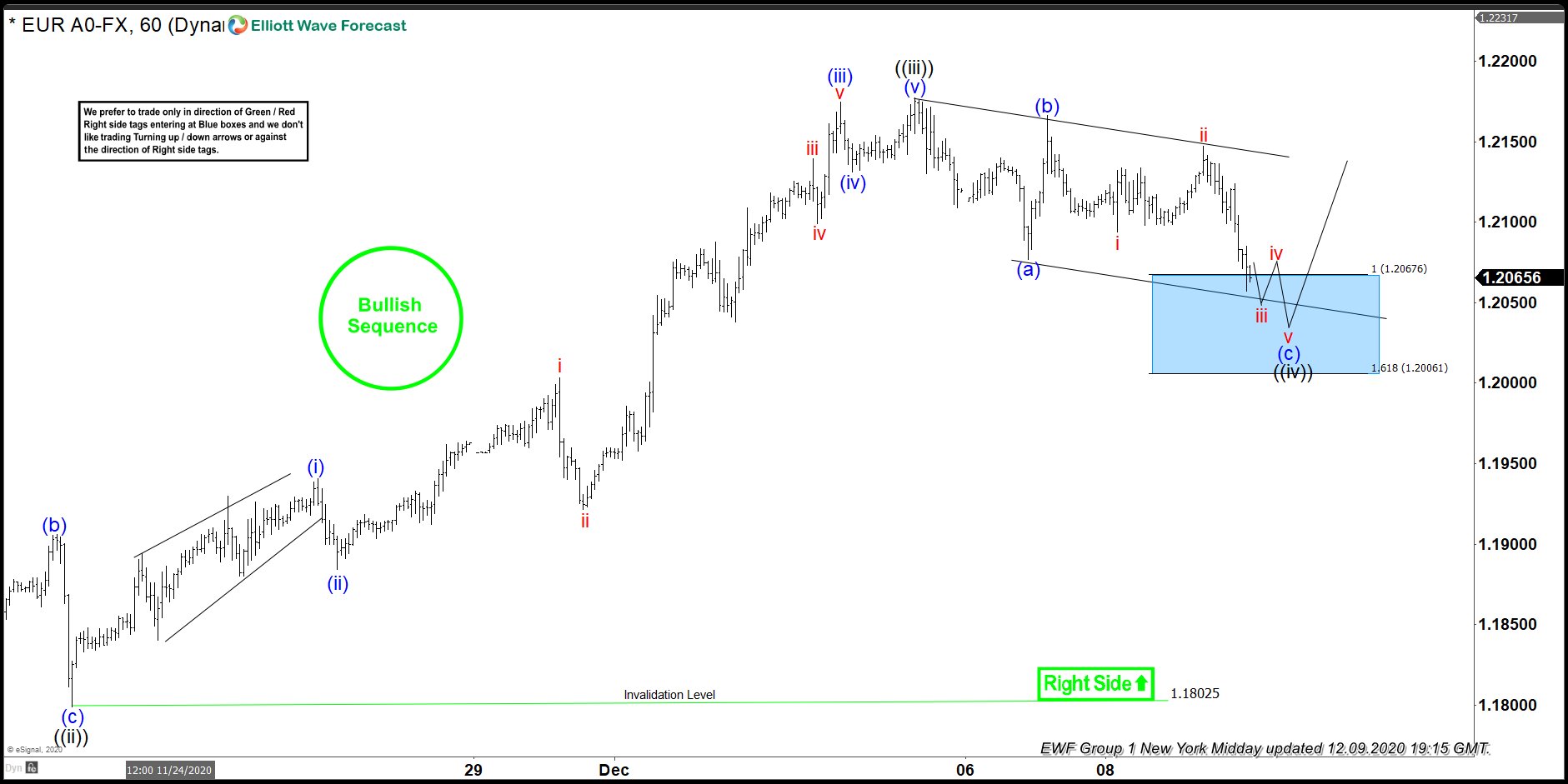
EURUSD [9 December 2020]
Price entered a blue box and our members knew that 3 waves correction should end in the blue box after which price should turn higher again.
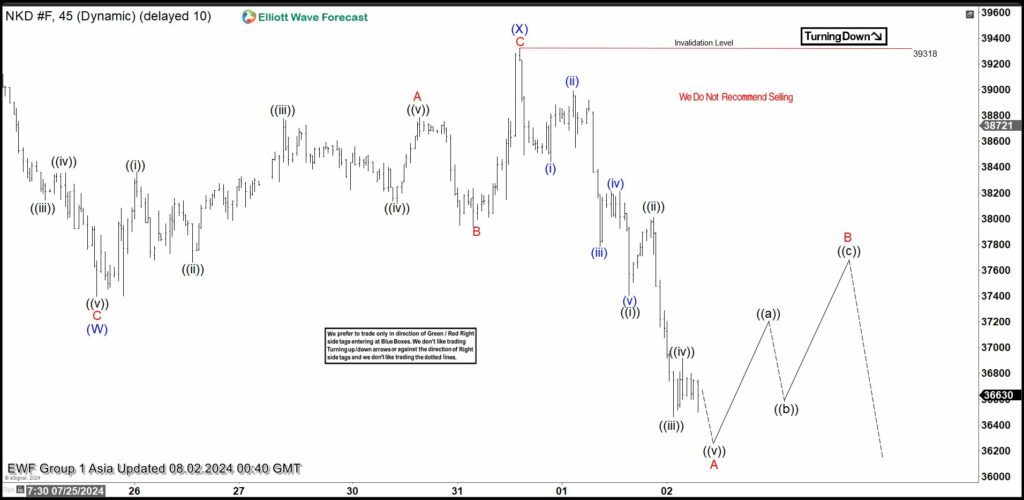
EURUSD [14 December 2020]
EUR/USD Pair found buyers in the blue box as expected and rallied 120+ pips in the next few days after hitting the blue box.v
GBP/USD can provide larger trading opportunities because of its higher volatility. While the pair often produces strong trending moves, traders should be prepared for deeper retracements and more aggressive price swings.
USD/JPY is another popular choice among Elliott Wave traders. Changes in global risk sentiment and central bank policy frequently create well-defined wave structures that can persist for extended periods.
AUD/USD and USD/CAD also present attractive opportunities because commodity prices often influence their directional movement, creating identifiable trends and corrections.
At Elliott Wave Forecast, our Forex coverage includes all major currency pairs, allowing traders to compare multiple wave structures and identify the strongest opportunities across the market.
Combining Elliott Wave with Technical Indicators
Although Elliott Wave Theory provides a comprehensive framework for market analysis, many traders improve their accuracy by combining wave analysis with additional technical tools.
The Relative Strength Index (RSI) is particularly useful for identifying momentum divergence. During Wave 5, price may continue making new highs while RSI fails to confirm the move. This divergence can provide an early warning that a reversal may be approaching.
MACD is another valuable indicator because it helps confirm trend strength and momentum acceleration. During Wave 3, MACD often displays strong bullish momentum, supporting the validity of the trend.
Fractal indicators can assist traders in identifying important swing highs and swing lows, while the Awesome Oscillator can help confirm momentum shifts between wave phases.
Moving averages are also commonly used to identify the broader trend direction and filter lower-quality setups.
At Elliott Wave Forecast, multiple layers of analysis are combined to improve confidence in wave counts and trading opportunities. Rather than relying on a single indicator, our approach focuses on market structure, Fibonacci relationships, momentum analysis, and risk management.
Common Elliott Wave Trading Mistakes
Many traders become frustrated with Elliott Wave Theory because they attempt to force patterns onto charts rather than objectively analyzing market structure.
One of the most common mistakes is becoming emotionally attached to a single wave count. Markets are dynamic, and valid alternate scenarios frequently exist. Successful Elliott Wave traders remain flexible and adapt when price action invalidates their preferred count.
Another common mistake is trading against the larger trend. While corrections can offer opportunities, trading in the direction of the dominant trend generally provides higher probabilities and better risk-to-reward ratios.
Many traders also focus excessively on finding perfect wave counts. In reality, Elliott Wave analysis is a probabilistic framework rather than a prediction tool. The goal is not to be correct 100% of the time but to identify scenarios where the reward justifies the risk.
Ignoring risk management is another major error. Even the best wave count can fail, making position sizing and stop-loss placement essential components of long-term success.
Risk Management: The Foundation of Long-Term Success
No trading strategy is complete without proper risk management.
Many traders spend years searching for the perfect entry technique while neglecting the factor that ultimately determines profitability: controlling losses.
Professional traders understand that uncertainty exists in every market environment. Rather than attempting to eliminate risk, they focus on managing it.
Most experienced traders risk only a small percentage of their trading capital on each position. Stop losses are placed at levels that invalidate the trade idea rather than arbitrary distances from entry.
Risk-to-reward ratios also play a critical role. A trader who consistently risks one unit to potentially earn three units does not need to win every trade to remain profitable.
At Elliott Wave Forecast, risk management is incorporated into every analysis. Each trade setup includes invalidation levels, allowing traders to understand both the opportunity and the associated risk before entering a position.
How Elliott Wave Forecast Helps Forex Traders
Learning Elliott Wave Theory can take years of study and practical experience. One of the biggest challenges traders face is the subjectivity involved in wave counting. Two traders can look at the same chart and arrive at completely different conclusions.
This is where professional analysis can provide tremendous value.
Elliott Wave Forecast covers more than 78 instruments across Forex, Stocks, Commodities, Cryptocurrencies, ETFs, and Indices. Members receive daily chart updates, professional wave counts, alternative scenarios, Blue Box trading opportunities, and ongoing market commentary.
Unlike automated systems that simply generate signals, our analysis is prepared by experienced Elliott Wave analysts who understand market structure, Fibonacci relationships, and sentiment dynamics.
Whether you’re trading EUR/USD, GBP/USD, Gold socks, the S&P 500, Bitcoin, or Crude Oil, professional Elliott Wave analysis can help you understand where the market is positioned within its broader cycle and what scenarios are most likely to unfold next.
Conclusion
Forex trading is ultimately about understanding market behavior and positioning yourself on the right side of high-probability opportunities. Elliott Wave Theory provides a powerful framework for accomplishing this by helping traders identify trends, corrections, reversals, and future price objectives.
By combining wave structure analysis with Fibonacci ratios, momentum indicators, and sound risk management principles, traders can develop a more complete understanding of how markets move. Rather than reacting emotionally to every price fluctuation, Elliott Wave traders focus on structure, probability, and disciplined execution.
While mastering Elliott Wave Theory requires patience and practice, the rewards can be significant. The ability to anticipate market direction, identify favorable entry points, and manage risk effectively can dramatically improve trading performance over time.
For traders seeking professional guidance, Elliott Wave Forecast provides daily analysis, Blue Box opportunities, and market coverage across more than 78 instruments, helping members stay ahead of market trends and make more informed trading decisions.
The market will always contain uncertainty. However, with a structured approach based on Elliott Wave Theory and professional market analysis, traders can navigate Forex markets with greater confidence, consistency, and long-term success.