Hello, fellow traders! If you’re new to Elliott Wave, this article will show you where to begin.
Elliott Wave Theory is one of the most powerful frameworks for understanding market cycles and anticipating potential price direction. It is based on the idea that shifts in investor psychology create recurring price patterns. These patterns can help traders identify the broader trend and distinguish impulsive moves from corrective ones. Traders can then prepare for potential opportunities with a structured plan.
Elliott Wave Theory provides a framework for interpreting nearly every type of price structure. However, learning its many patterns and variations can take months—or even years—to master. Fortunately, you do not need to learn everything at once. Every journey begins with a single step. One of the most important structures to understand first is the 3-wave correction.
Corrective market moves frequently unfold in three waves. Sometimes, the structure is clear and easy to recognize. At other times, it requires a closer examination of the internal price action. Learning to recognize 3-wave corrections can help traders avoid chasing the market. It can also improve the timing of their entries.
Once you have identified the primary trend and established a clear directional bias, patience becomes crucial. Entering immediately after a strong move may leave you exposed to an unfinished correction. This can result in a premature stop-out. Instead, wait for a 3-wave corrective structure to develop against the prevailing trend. Once complete, it may provide a better-defined opportunity to trade in the direction of the larger trend with clearer risk parameters.
In the example below, the market advances within an uptrend before producing a 3-wave pullback labeled W-X-Y. Depending on its internal structure, the correction may be labeled either A-B-C or W-X-Y. Although the labeling differs, the principle remains the same. The correction unfolds against the larger trend and may create a potential trading opportunity once the structure is complete.
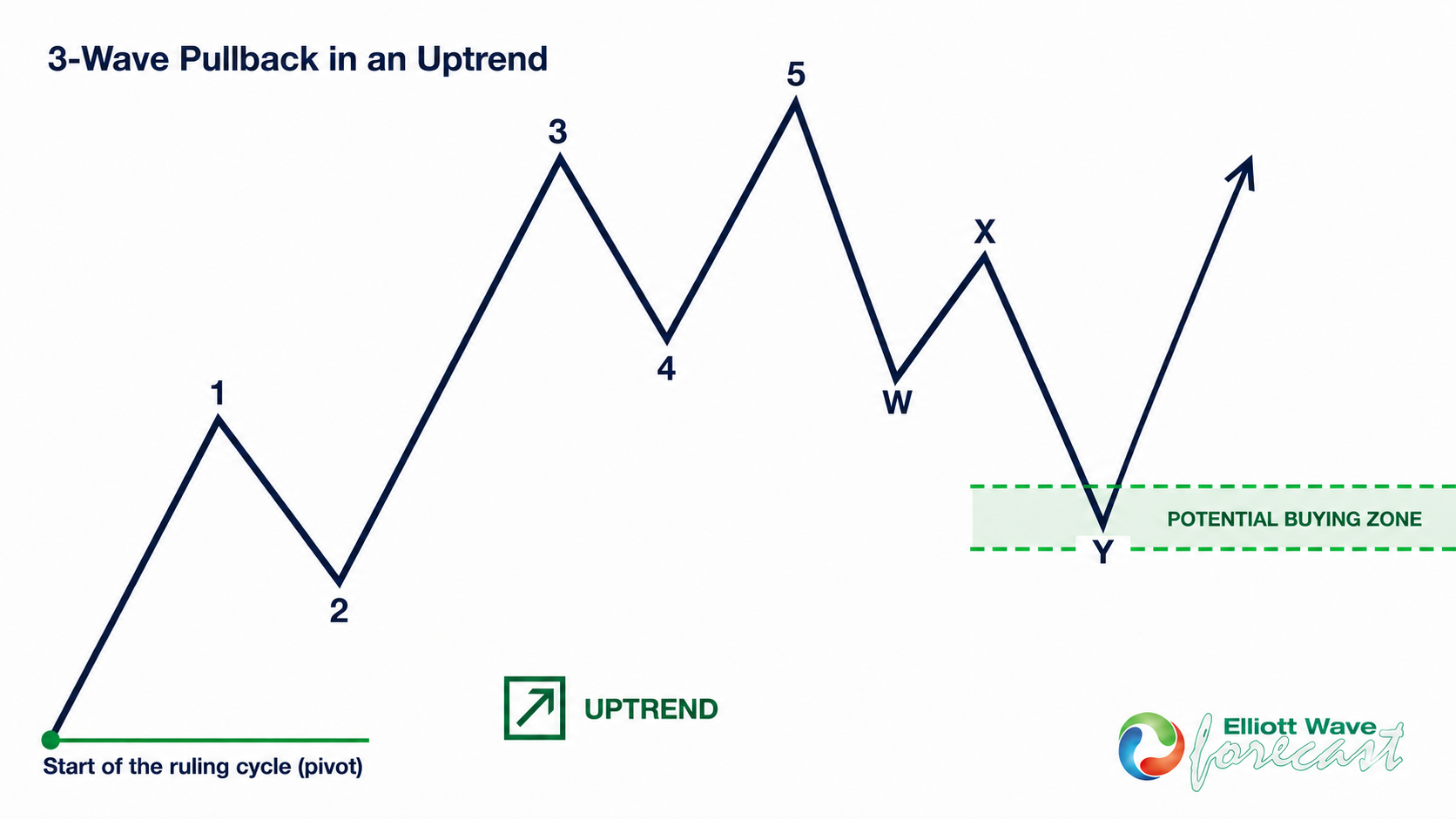
Once you identify a clear trend, it can be tempting to enter the market immediately. However, entering before a 3-wave correction has completed can lead to poor timing and premature stop-outs. A more disciplined approach is to first establish the prevailing trend and then wait for a 3-wave correction to develop.
If you’re unsure where to begin with Elliott Wave, start by learning to identify 3-wave corrective structures on real market charts. Mastering this essential skill will give you a strong foundation for reading price action and improving your trade timing.
You can learn more about Elliott Wave Patterns at our Free Elliott Wave Educational Web Page
Over the years, we’ve developed a proven trading strategy that combines this approach. It helps to define precise Entry, Stop Loss, and Take Profit levels, allowing you to enter trades with confidence. Even better, this strategy helps make your positions risk-free shortly after entering, providing added protection for your trading account.