In this Elliott Wave update, we take a look at the latest structure in Roundhill Magnificent Seven ETF ($MAGS). The ETF is trading at an interesting juncture as it continues to correct the cycle from the March 2026 low. At this stage, it remains unclear whether the correction has already ended at the June 11 low or whether one more leg lower is still needed before buyers regain full control.
That uncertainty makes the June 11 low the key pivot in the short term. If price continues to hold above that level, the pullback may already be complete and the next leg higher can start to develop. However, if $MAGS breaks below the June 11 low, then the correction likely remains incomplete and more downside can unfold toward the March low area at 59–54.
$MAGS Is Correcting the Cycle From the March 2026 Low
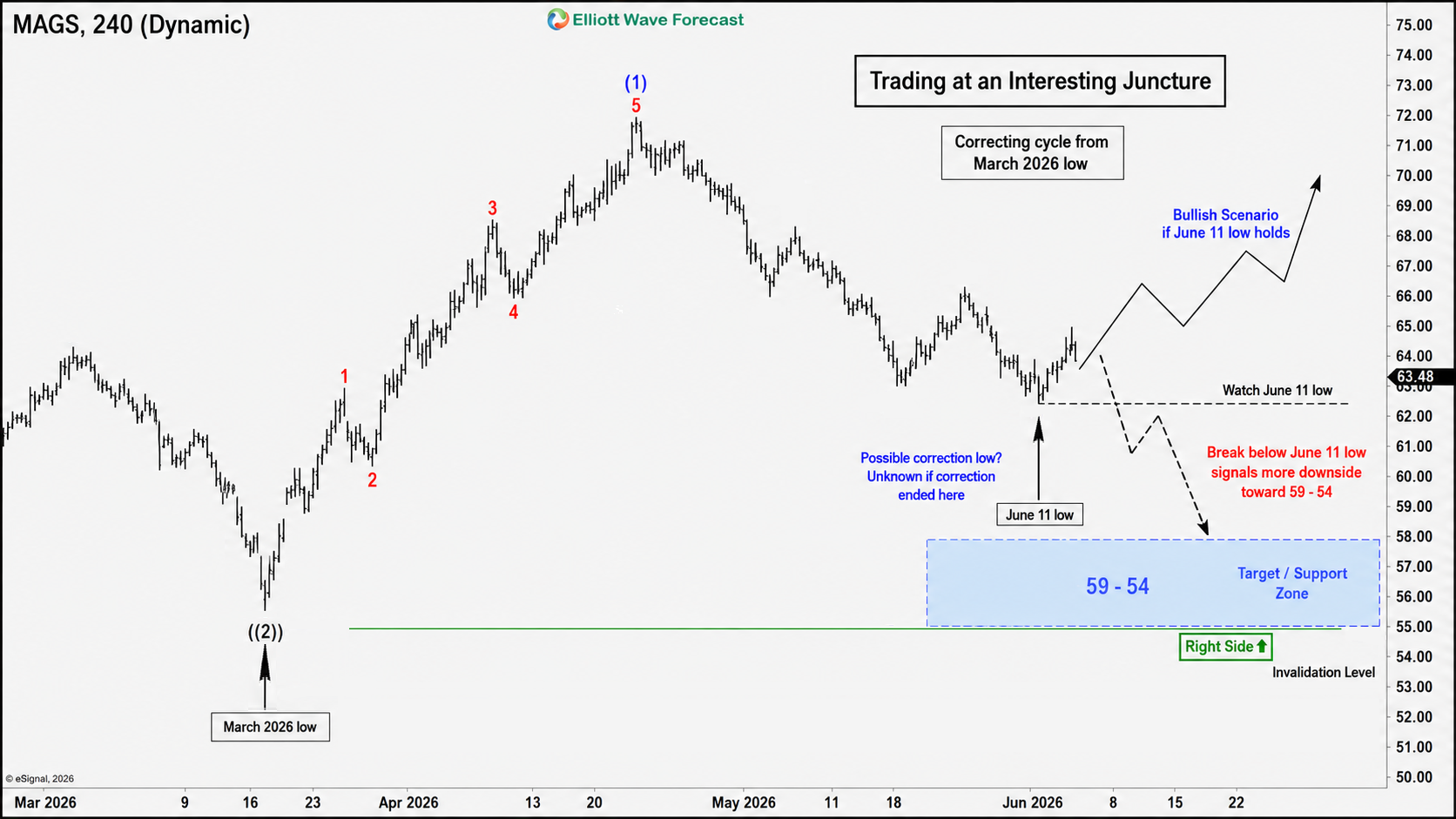
Looking at the 4-hour chart, $MAGS started a strong bullish cycle from the March 2026 low and rallied into a spring peak. After that advance, the ETF turned lower and entered a corrective phase. Since then, price action has remained choppy and overlapping, which supports the view that the move lower is corrective rather than a fresh impulsive bearish trend.
Even so, the correction has not yet provided a fully confirmed completion signal. As a result, traders now need to focus on the June 11 low as the line that can help determine the next directional move.
June 11 Low Is the Decision Point
Most importantly, the June 11 low now acts as the key near-term support. If buyers continue to defend that pivot, then $MAGS may have already completed the pullback and could resume higher from current levels. In that scenario, the recent rebound would likely mark the early stages of a new push higher within the broader bullish sequence from March.
On the other hand, if price breaks below the June 11 low, that would strongly suggest the correction is not finished yet. In that case, the ETF can extend lower and revisit the March lows again, with the next important downside zone coming in around 59–54.
What the 59–54 Area Means
The 59–54 area stands out as the next major support region if the June 11 low fails. This zone sits near the March low region and would represent an important area where buyers may try to step back in again. Therefore, a break below June 11 would not just signal weakness in the short term. It would also increase the probability that the market needs a deeper retracement before the broader bullish cycle can resume.
For that reason, the current structure should be monitored closely. The market is not yet offering a fully resolved bullish or bearish outcome. Instead, it is sitting at a pivot where the next break should provide the answer.
Near-Term Outlook for $MAGS
In the near term, two scenarios remain in play. First, if the June 11 low holds, $MAGS can continue building a recovery and push higher from the current area. Second, if that low breaks, the correction should extend lower toward 59–54 before a more meaningful low is in place.
Accordingly, traders should stay flexible and let price confirm the next path. The setup is clear: hold above June 11 and the bullish case improves, break below it and the downside opens toward the March lows.
Technical Summary
To summarize, $MAGS is correcting the cycle from the March 2026 low and is now trading at an important inflection point. At the moment, it remains unknown whether the correction ended at the June 11 low or whether more downside is still ahead.
As long as the June 11 low holds, the ETF can recover and resume higher. However, a break below that level would signal that the correction remains incomplete and can send $MAGS back toward the March support area at 59–54.