To navigate the oil market effectively, you have to look past the retail gas pump and understand that crude oil is the world’s most heavily traded, geopolitically sensitive commodity.
Whether you are tracking it to trade futures, analyze energy stocks, or map macro cycles, the market moves based on a distinct set of gears.
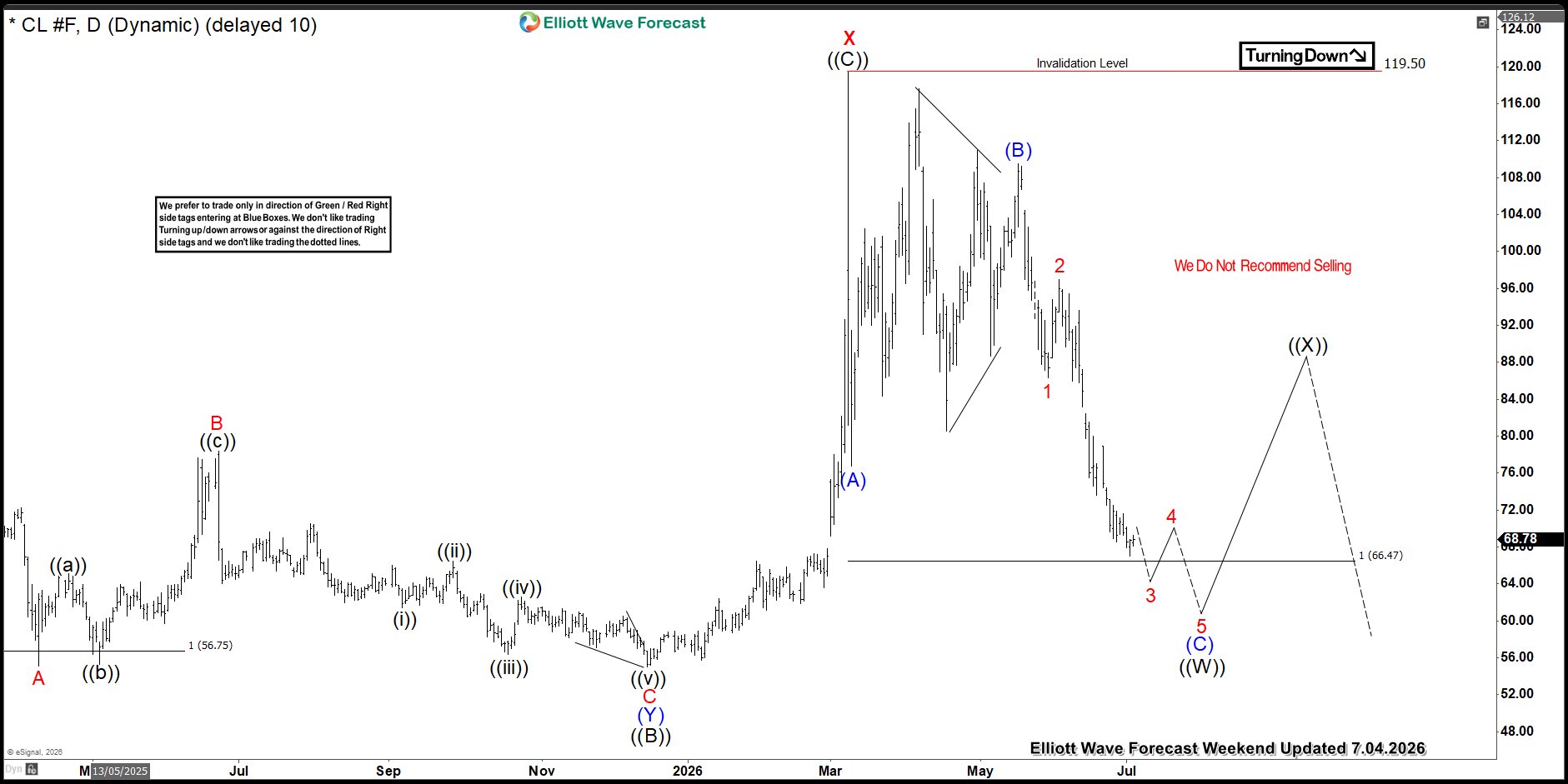
The chart above illustrates the Elliott Wave path that EWF favors or is currently monitoring as the next potential scenario.
- The Two Global Benchmarks
Not all crude oil is the same. The market prices oil based on its “weight” (API gravity) and “sweetness” (sulfur content). Low-sulfur (“sweet”), low-density (“light”) oil is the easiest to refine into gasoline and diesel, commanding a premium. The two primary benchmarks are:
- WTI (West Texas Intermediate): The U.S. benchmark. It is a light, sweet crude primarily sourced from the Permian Basin and landlocked in Cushing, Oklahoma.
- Brent Crude: The global benchmark. It is a light, sweet crude sourced from the North Sea, but used to price roughly two-thirds of the world’s internationally traded oil.
- The Spread: The price difference between Brent and WTI (the Brent-WTI spread) fluctuates based on shipping costs, U.S. export capacity, and regional geopolitical risk. A widening spread usually implies heavy international tension or a bottleneck in U.S. transport pipelines.
- Supply: The Structural Game of Chess
Oil supply is dictated by a constant push-and-pull between state-controlled cartels and private market dynamics:
- OPEC+: The Organization of the Petroleum Exporting Countries (plus allies like Russia). OPEC+ holds the vast majority of the world’s spare capacity (the ability to turn oil taps on or off rapidly). They manage prices by setting strict production quotas to artificially tighten or loosen the market.
- S. Shale & Non-OPEC: Private operators (mainly in the U.S., Canada, and Brazil) respond directly to market prices. When prices are high, U.S. shale producers can ramp up drilling rapidly, capping OPEC’s ability to drive prices too high without losing market share.
- Demand: The Economic Engine
Oil demand is tightly tethered to global GDP. When economies expand, manufacturing, commercial shipping, and aviation demand explode.
- The Refining Bottleneck: Crude oil is useless until it is processed. Refiners buy crude and turn it into products (gasoline, diesel, jet fuel, petrochemicals).
- Crack Spreads: This is the profit margin a refiner makes by buying a barrel of crude and “cracking” it into refined products. Even if crude oil prices are stable, a high crack spread indicates massive consumer demand for fuel, which eventually pulls crude prices higher.
- The Anatomy of Oil Cycles
The market moves through classic technical and fundamental phases, heavily driven by inventory data:
- Inventory Reports: Traders closely watch weekly inventory reports (like the U.S. EIA data). If inventories are shrinking (“drawing”), it indicates demand is outpacing supply, triggering bullish price action.
- Contango vs. Backwardation:
- Contango: A market structure where the future price of oil is higher than the current spot price. This signals oversupply; it incentivizes traders to buy cheap oil now, store it in tankers, and sell it later for a profit.
- Backwardation: The opposite structure, where current spot oil is more expensive than future contracts. This signals extreme near-term scarcity, forcing buyers to pay a massive premium for immediate delivery.
- Macro Triggers to Watch
If you are analyzing the oil market day-to-day, your radar should always include:
- The U.S. Dollar (DXY): Oil is globally priced in U.S. dollars. When the dollar strengthens, oil technically becomes more expensive for foreign buyers using other currencies, creating a natural headwind for oil prices.
- Geopolitical Chokepoints: Roughly 20% of the world’s oil transits through the Strait of Hormuz (Middle East), and significant volumes pass through the Suez Canal and Strait of Malacca. Any regional conflict or shipping blockade near these lanes triggers immediate, violent upside risk premiums.
- The Energy Transition: Long-term secular trends—like EV adoption and efficiency mandates—act as a gradual weight on demand growth, transitioning the market from an era of “how much oil is left?” to “when will global demand peak?
You don’t need to transport or handle physical oil or petroleum products to participate in the energy market. Instead, you can gain exposure through the stock market by investing in the major companies that manage the physical side of the industry.
That naturally leads us to the Top 10 Oil Stocks investors should keep on their radar.
Top 10 OIL Stocks to Watch in 2026
The global energy landscape continues to evolve, balancing traditional hydrocarbons with the accelerating transition toward renewables. Yet oil remains a cornerstone of global energy supply, and the leading companies in this sector are delivering strong cash flows, dividends, and strategic pivots. Below, we explore the 10 oil stocks dominating 2026.
| Rank | Company | Ticker | Market Cap | Dividend Yield | Segment |
| 1 | ExxonMobil | XOM | $568.2B | 2.98% | Integrated major |
| 2 | Chevron | CVX | $337.0B | 4.13% | Integrated major |
| 3 | ConocoPhillips | COP | $127.6B | 3.15% | Upstream |
| 4 | Shell | SHEL | $200.0B+ | 3.5% | Integrated major |
| 5 | TotalEnergies | TTE | $160.0B+ | 5% | Integrated major |
| 6 | BP | BP | $100.0+ | 4% | Integrated major |
| 7 | Enbridge | ENB | $118.1B | 5.12% | Midstream |
| 8 | EOG Resources | EOG | $69.7B | 3.09% | Upstream |
| 9 | Valero Energy | VLO | $50.0B+ | 2.00% | Refining |
| 10 | Marathon Petroleum | MPC | $60.0B+ | 1.72% | Refining |
Integrated Majors: Stability & Scale
ExxonMobil (XOM)
With a market cap above $560B, ExxonMobil remains the benchmark for integrated oil. Its record cash flows, LNG expansion, and carbon capture investments position it as both a hydrocarbon powerhouse and a transition leader.
Chevron (CVX)
Chevron’s disciplined capital spending and low-cost Permian assets make it a resilient operator. A 4%+ dividend yield adds appeal for income-focused investors.
Shell (SHEL)
Shell balances upstream oil with LNG and renewables. Its pivot toward hydrogen and EV charging infrastructure underscores its dual focus on hydrocarbons and clean energy.
TotalEnergies (TTE)
TotalEnergies boasts one of the largest renewable pipelines among oil majors, while maintaining strong upstream operations. Its ~5% dividend yield attracts conservative investors.
BP (BP)
BP continues its transformation, investing heavily in solar, wind, and EV charging. Despite ESG pressures, its diversified portfolio ensures relevance in the energy transition.
Upstream Producers: Oil Price Leverage
ConocoPhillips (COP)
A shale leader with robust free cash flow, ConocoPhillips thrives on oil price strength. Its disciplined approach to shareholder returns makes it a growth and income hybrid.
EOG Resources (EOG)
EOG’s low breakeven shale assets and strong balance sheet give it leverage to crude rallies. It remains a favorite among growth-oriented investors.
Midstream: Defensive Cash Flows
Enbridge (ENB)
As North America’s pipeline giant, Enbridge generates toll-like revenues insulated from oil price volatility. Its 5%+ dividend yield makes it a defensive play in the sector.
Refiners: Margin Plays
Valero Energy (VLO)
Valero benefits from strong Gulf Coast refining margins. Its positioning in renewable diesel adds a growth kicker.
Marathon Petroleum (MPC)
Marathon’s refining scale and disciplined capital allocation drive consistent cash flow. Dividend growth enhances its appeal for long-term investors.
Advantages of Oil Stocks
- Strong Cash Flow Generation Oil majors like ExxonMobil and Chevron consistently deliver robust free cash flows, supporting dividends and buybacks.
- Attractive Dividend Yields Integrated majors and midstream players (e.g., Chevron, Enbridge) offer reliable income streams, often above 4–5%.
- Inflation Hedge Energy stocks tend to perform well during inflationary cycles, as commodity prices rise with global cost pressures.
- Global Demand Resilience Despite the energy transition, oil remains essential for transportation, petrochemicals, and industrial use — ensuring long‑term relevance.
- Diversification Across Segments Exposure to upstream, midstream, and refining companies provides a mix of growth, stability, and tactical margin plays.
- Energy Transition Upside European majors (Shell, BP, TotalEnergies) are investing heavily in renewables, hydrogen, and EV infrastructure, offering dual exposure to hydrocarbons and clean energy.
- Geopolitical Premiums Oil prices often spike during global conflicts or supply disruptions, benefiting upstream producers and refiners.
- Cyclical Growth Opportunities Upstream names like ConocoPhillips and EOG Resources thrive when crude rallies, offering leveraged upside.
Disadvantages of Oil Stocks
- High Price Volatility Oil stocks are heavily tied to crude price swings, which can be triggered by geopolitical events, OPEC+ decisions, or demand shocks.
- Geopolitical Risk Exposure Conflicts in the Middle East, sanctions, or supply disruptions can destabilize earnings and valuations.
- Energy Transition Pressure Global decarbonization policies, ESG mandates, and the rise of renewables put long‑term demand for oil under scrutiny.
- Regulatory & Environmental Challenges Stricter climate regulations, carbon taxes, and litigation risks can weigh on profitability.
- Cyclical Downturns Oil demand is cyclical; recessions or oversupply periods can lead to sharp declines in revenue and stock performance.
- Dividend Sustainability Concerns While yields are attractive, payouts may be cut during prolonged downturns, especially for upstream producers.
- Capital Intensity Exploration, production, and refining require massive capital expenditures, which can limit flexibility compared to other sectors.
- Currency & Emerging Market Risk Many oil companies operate in countries with volatile currencies or political instability, adding another layer of risk.
Final Thoughts on Investing in Oil Stocks
Oil stocks remain a powerful way to gain exposure to the global energy market without dealing directly in physical commodities. They offer investors a mix of cash flow stability, dividend income, and cyclical growth potential, while also providing selective exposure to the energy transition through majors investing in renewables.
That said, the sector is not without challenges. Volatility, geopolitical risks, and regulatory pressures are constant factors that require disciplined risk management. The key is to balance your portfolio — combining integrated majors for stability, upstream producers for growth, and midstream/refiners for diversification.
Bottom Line: Oil stocks can be a rewarding addition to a portfolio when approached strategically. They are best suited for investors who understand the cyclical nature of energy markets and are prepared to navigate both the opportunities and the risks.
Why Choose EWF ?
At Elliottwave Forecast (EWF), we deliver consistent market updates through regular charts update. Our analysts update 1‑hour charts four times daily and 4‑hour charts once per day across all 78 instruments. In addition, we host five live sessions each day and maintain a 24‑hour chatroom, providing clients with real‑time market guidance and answers to any questions they may have.
You can start a 14‑day trial with us today here and cancel anytime by emailing support@elliottwave-forecast.com
I am text block. Click edit button to change this text. Lorem ipsum dolor sit amet, consectetur adipiscing elit. Ut elit tellus, luctus nec ullamcorper mattis, pulvinar dapibus leo.