The five-wave structure is the foundation of Elliott Wave Theory and describes how markets move in a trending phase. It reflects the progression of market psychology from pessimism to optimism, forming a predictable pattern of price movement.
Understanding the Elliott Wave five-wave structure allows traders to identify trend direction, anticipate future price movements, and locate high-probability trading opportunities. The Elliott Wave Theory explains how market trends develop through recurring wave patterns driven by investor psychology.
Quick Guide: What is the Five-Wave Structure?
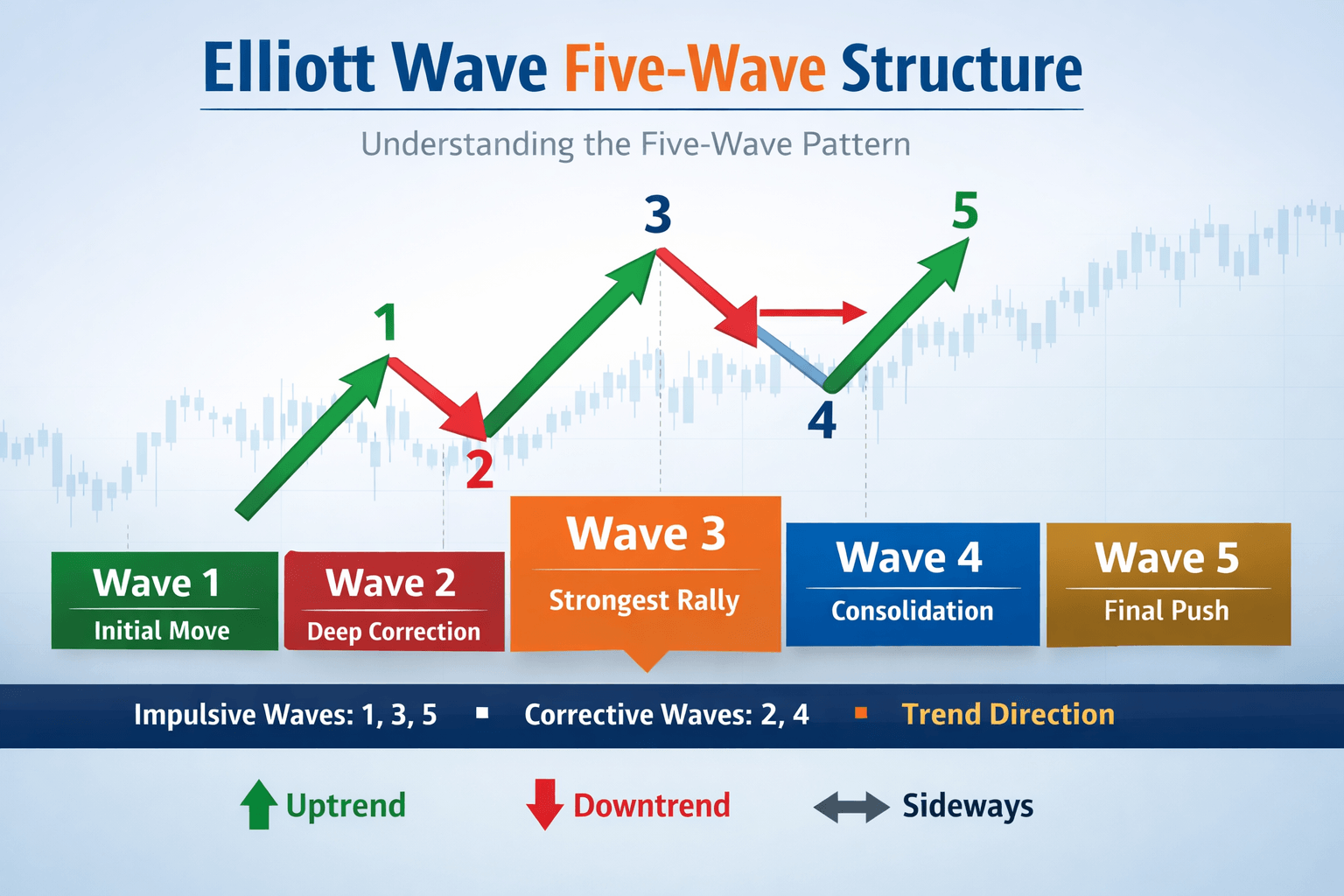
The five-wave structure consists of five waves labeled:
- Wave 1 – Initial move
- Wave 2 – Correction
- Wave 3 – Strongest trend wave
- Wave 4 – Consolidation
- Wave 5 – Final move
Waves 1, 3, and 5 move in the direction of the main trend, while Waves 2 and 4 are corrective. The five-wave structure is closely related to Elliott Wave impulse waves, which represent the trending phase of the market.
Wave Personality in the Five-Wave Structure
Each wave in the five-wave structure reflects a specific stage of investor sentiment and market behavior. Recognizing these characteristics helps traders identify where the market is within the trend.
 1. Wave 1 – The Beginning of the Trend
Wave 1 marks the start of a new trend, but most traders do not recognize it.
Key characteristics:
- Low confidence in the market
- Often follows a strong correction
- Moderate increase in volume
- Many traders continue short selling
Wave 1 typically forms a base and is often retraced significantly by Wave 2.
2. Wave 2 – Deep Retracement
Wave 2 retraces a large portion of Wave 1.
Key characteristics:
- Strong fear and uncertainty
- Many traders believe the trend has failed
- Sharp correction
- Cannot retrace more than 100% of Wave 1
This phase often creates opportunities for early trend entries.
Waves 2 and 4 are Elliott Wave corrective waves that temporarily move against the main trend.
3. Wave 3 – The Strongest Move
Wave 3 is usually the most powerful and extended wave in the five-wave structure.
Key characteristics:
- Strong momentum and volume
- Broad market participation
- Breakouts and continuation moves
- High confidence among traders
Wave 3 is never the shortest wave and often delivers the largest gains. Momentum indicators such as Relative Strength Index (RSI) trading strategies can help confirm the strength of Wave 3 and Wave 5.
4. Wave 4 – Consolidation Phase
Wave 4 is a corrective and sideways movement.
Key characteristics:
- Lower volatility
- Sideways price action
- Alternates in structure compared to Wave 2
- Prepares the market for the final move
This phase builds the base for Wave 5.
5. Wave 5 – Final Trend Move
Wave 5 completes the five-wave structure.
Key characteristics:
- High optimism in the market
- Slower momentum compared to Wave 3
- Divergence often appears
- Narrowing market participation
Wave 5 often signals that the trend is nearing completion.
If you want to see how analysts apply the five-wave structure in real markets, you can subscribe to our plans and access live forecasts.
Key Rules of the Five-Wave Structure
To correctly identify the Elliott Wave five-wave structure, traders follow these rules:
- Wave 2 cannot retrace more than 100% of Wave 1
- Wave 3 cannot be the shortest wave
- Wave 4 cannot overlap Wave 1
These rules ensure accurate wave counting and analysis.
How Traders Use the Five-Wave Structure
Traders use the five-wave structure to:
- Identify trend direction
- Find entry and exit points
- Predict continuation moves
- Combine with Fibonacci retracement levels
- Confirm setups using indicators like RSI
This approach helps traders align with the market trend rather than trade against it. The five-wave structure is often used alongside chart patterns in technical analysis to improve trade confirmation.
Real Market Application
The five-wave structure appears across all financial markets:
- Forex (EURUSD, GBPUSD): The five-wave structure regularly appears in major currency pairs such as the EURUSD forecast.
- Indices (S&P 500, Nasdaq): The five-wave structure can also be tracked in equity indices through the Nasdaq forecast.
- Commodities (Gold, Oil): Commodity traders also look for impulse structures in the Gold forecast to identify trend continuation opportunities.
- Cryptocurrencies
Index traders often use the S&P 500 forecast to monitor whether a trend is developing through a five-wave sequence.
By analyzing these markets using Elliott Wave, traders can anticipate future price movements more effectively.
Applying Elliott Wave Theory in Trading
To apply the five-wave structure effectively:
Wave Counting
Each impulse phase must consist of five waves, while corrections consist of three waves.
Fibonacci Relationships
Wave relationships often follow Fibonacci ratios, especially Wave 3 relative to Wave 1. Traders often use Fibonacci retracement and Fibonacci extension levels to estimate retracement zones and wave targets.
Retracement Levels
Corrective waves typically retrace between 38.2% and 61.8% of the previous move.
Channeling
Drawing trend channels helps identify support and resistance within the wave structure.
Risk Management
Even with strong analysis, traders must manage risk:
- Use stop-loss orders
- Maintain proper position sizing
- Adjust strategy if wave count changes
Elliott Wave analysis provides probabilities, not certainty.
Follow Professional Elliott Wave Analysis
If you want to see how analysts apply the five-wave structure in real markets, you can follow live forecasts across forex, indices, commodities, and crypto.
Start your 14 Day Trial here>>
Frequently Asked Questions
What is the five-wave structure in Elliott Wave?
The five-wave structure is a trend pattern consisting of five waves that move in the direction of the main market trend.
Which wave is strongest in the five-wave structure?
Wave 3 is typically the strongest and longest wave.
What happens after the five-wave structure?
After the five-wave structure completes, the market usually enters a corrective phase.
Is the five-wave structure reliable?
It is widely used in technical analysis and works best when combined with other tools like Fibonacci and momentum indicators.
Conclusion
The Elliott Wave five-wave structure provides a powerful framework for understanding market trends and investor psychology. By mastering this structure, traders can better anticipate price movements and identify high-probability trading opportunities.
When combined with proper risk management and technical tools, the five-wave structure becomes an essential part of a successful trading strategy.