Forex signals have existed for decades. Yet in 2026, they are more misunderstood than ever.
Some traders treat them as shortcuts to profit. Others dismiss them entirely as scams. Both views miss the point.
Forex signals are not about prediction. They are about probability, structure, and decision-making under uncertainty.
When built correctly, signals help traders:
- Define directional bias
- Manage risk objectively
- Avoid emotional and impulsive trades
- Stay aligned with higher-timeframe structure
When built poorly, they create dependency, false confidence, and inconsistent results.
This guide explains what forex signals really are, how they differ across methodologies, and why forecast-driven signals based on market structure (like those used at Elliott Wave Forecast) are fundamentally different from generic buy/sell alerts.
What Are Forex Signals? (Clear, Practical Definition)
Forex signals are structured trade ideas that outline a probable market direction, key price levels, and conditions under which the idea remains valid or fails.
A professional-grade forex signal always answers five questions:
- What is the market bias? Bullish, bearish, or corrective.
- Where does participation make sense? An entry zone, not a single price.
- Where is the idea invalidated? The level that proves the analysis wrong.
- What is the expected outcome? Targets, extensions, or structural continuation.
- On which timeframe does this idea operate? Intraday, swing, or multi-week.
If a signal does not clearly answer all five, it is incomplete.
Why the Term “Forex Signals” Is Misleading
The phrase “forex signals” suggests something mechanical — a trigger, alert, or command.
In reality, good signals are analytical frameworks, not instructions.
Most retail traders are exposed to signals through:
- Telegram alerts
- Social media screenshots
- Auto-execution services
- “Guaranteed win rate” marketing
These formats remove context and exaggerate certainty.
Professional traders, on the other hand, use signals as decision support, not as execution orders.
Forex technical analysis is the process of analyzing currency price movements using charts, indicators, and market patterns to anticipate future direction.
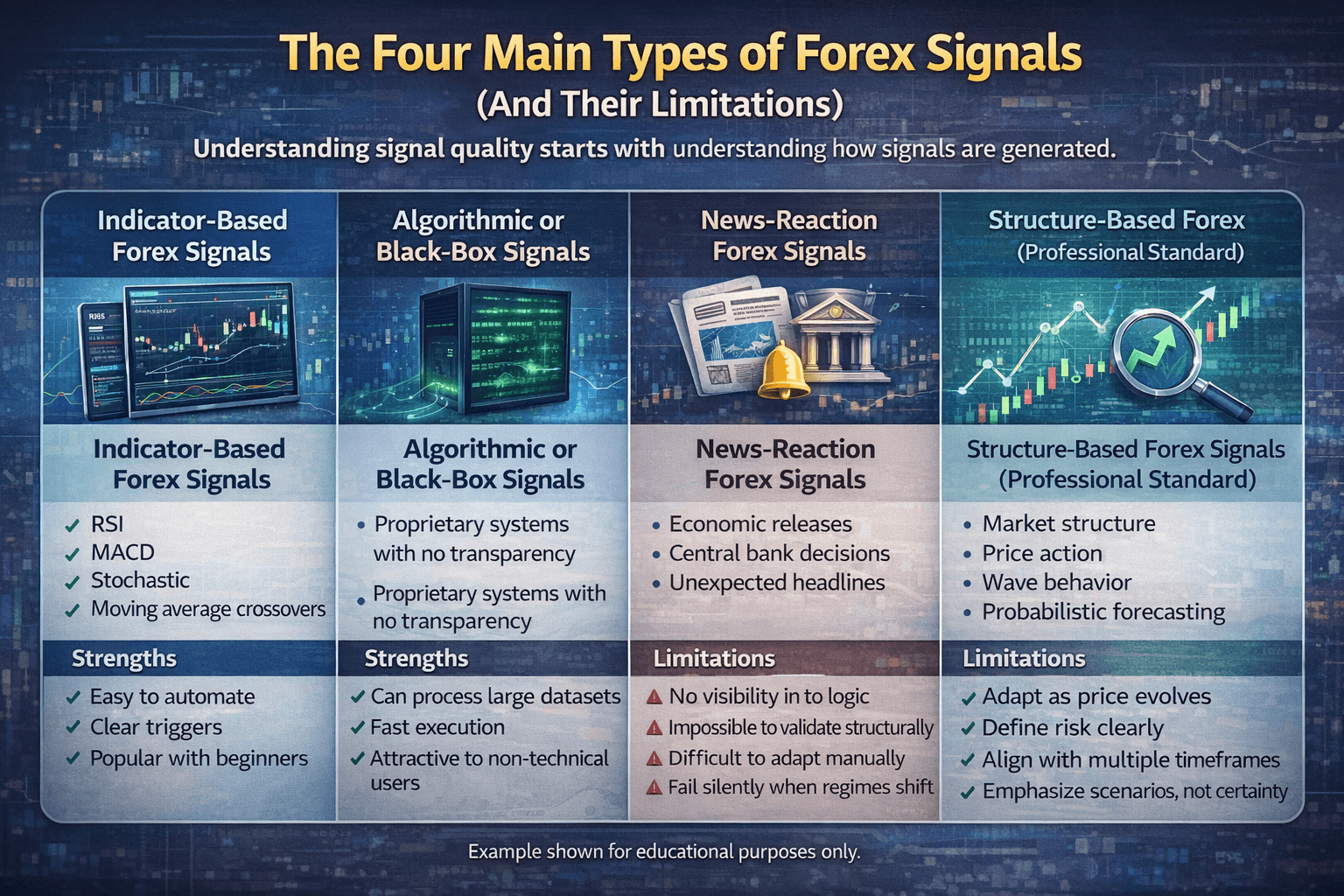
The Four Main Types of Forex Signals (And Their Limitations)
Understanding signal quality starts with understanding how signals are generated.
1. Indicator-Based Forex Signals
These rely on technical indicators such as:
- RSI
- MACD
- Stochastic
- Moving average crossovers
Strengths
- Easy to automate
- Clear triggers
- Popular with beginners
Limitations
- Lagging by design
- Perform poorly in ranging or news-driven markets
- Generate excessive false positives
- Do not explain why price should move
Indicator signals often work temporarily, then fail as conditions change.
2. Algorithmic or Black-Box Signals
These are generated by proprietary systems with no transparency.
Strengths
- Can process large datasets
- Fast execution
- Attractive to non-technical users
Limitations
- No visibility into logic
- Impossible to validate structurally
- Difficult to adapt manually
- Fail silently when regimes shift
Traders are left trusting outcomes without understanding risk.
3. News-Reaction Forex Signals
These react to:
- Economic releases
- Central bank decisions
- Unexpected headlines
Strengths
- Capture volatility
- Can produce fast moves
Limitations
- Extremely timing-sensitive
- Poor risk-to-reward consistency
- Often reverse quickly
- Not repeatable as a system
News signals are situational tools, not sustainable strategies.
4. Structure-Based Forex Signals (Professional Standard)
These signals are derived from:
- Market structure
- Price action
- Wave behavior
- Probabilistic forecasting
Strengths
- Adapt as price evolves
- Define risk clearly
- Align with multiple timeframes
- Emphasize scenarios, not certainty
This is the category used by Elliott Wave–based forecasting.
What Makes Elliott Wave–Based Forex Signals Different
At Elliott Wave Forecast, forex signals are not marketed as “trade alerts.” They are forecast scenarios built from Elliott Wave structure.
Instead of issuing fixed instructions, the analysis answers:
- Where are we in the market cycle?
- What paths are most likely next?
- What price behavior confirms or invalidates those paths?
This distinction changes everything.
You can explore how these structure-based signals work in real time by starting a 14-Day Trial of our Elliott Wave forex forecasting service.
How Elliott Wave Forex Signals Are Built
Elliott Wave analysis assumes that markets move in repeating, fractal structures driven by crowd psychology.
These signals are derived from a broader Elliott Wave forecasting framework that evaluates wave position, momentum, and corrective depth.
Core Components of an Elliott Wave Forex Signal
- Wave Position Identifies whether price is in:
- Impulse
- Correction
- Extension
- Transition
- Primary Scenario The most probable path based on structure.
- Alternative Scenario A secondary path if the primary is invalidated.
- Invalidation Level The price level that proves the count wrong.
- Target Zones Derived from wave relationships, not arbitrary pips.
This approach creates decision trees, not predictions.
Forex Signals vs Forecasts: A Crucial Distinction
Most signal services tell you what to do.
Forecast-driven signals tell you what to expect.
| Aspect | Generic Signals | Forecast-Driven Signals |
|---|---|---|
| Focus | Entry alerts | Market structure |
| Risk | Often implied | Explicit invalidation |
| Flexibility | Static | Adaptive |
| Learning | None | High |
| Longevity | Short | Compounding |
Forecasts empower traders to adapt, even when the market surprises.
Why Forex Signals Fail for Most Traders
Signals themselves are not the problem. Misuse is.
Common Failure Points
- Treating signals as guaranteed outcomes
- Ignoring invalidation levels
- Over-leveraging due to false confidence
- Trading every signal instead of filtering
- Mixing signals across incompatible timeframes
Signals amplify behavior. Poor discipline produces poor results faster.
Explore the pros and cons of forex vs options trading to determine which market structure aligns best with your trading style.
When Forex Signals Actually Help Traders
Forex signals are most effective when used as filters, not crutches.
Signals Help Most When:
- You struggle with directional bias
- You overtrade during consolidation
- You chase price emotionally
- You lack higher-timeframe context
- You want objective risk boundaries
They are least effective when used as blind automation. Understanding the best trading hours in the forex market can help traders align entries with peak liquidity and volatility for more efficient execution.
The Role of Timeframes in Forex Signals
One of the most misunderstood aspects of forex signals is timeframe alignment.
Why Timeframe Context Matters
A bullish signal on a 15-minute chart can fail easily if:
- The daily structure is corrective
- The weekly trend is exhausted
- Price is near a higher-timeframe resistance
Elliott Wave–based signals always anchor lower-timeframe ideas to higher-timeframe structure.
This prevents:
- Counter-trend overtrading
- Chasing late moves
- Misinterpreting corrections as reversals
Choosing the best forex currency pairs helps traders focus on markets with stronger liquidity, clearer trends, and more consistent trading opportunities.
Forex Signals in Trending vs Ranging Markets
Signals behave differently depending on market phase.
Trending Markets
- Impulse waves dominate
- Pullbacks are opportunities
- Risk-to-reward improves
- Holding winners matters more than precision
Ranging or Corrective Markets
- Overlapping price action
- False breakouts increase
- Patience becomes edge
- Many signals are deliberately avoided
Knowing when not to trade is a hidden advantage of forecast-driven signals. Explore the pros and cons of forex vs stocks to determine which market aligns best with your forex vs stocks trading goals and experience level.
Risk Management: The Missing Piece in Most Forex Signals
A signal without risk context is dangerous.
Professional Signals Always Define:
- Maximum acceptable loss
- Structural invalidation
- Position sizing logic
- Scenario probabilities
Elliott Wave Forecast emphasises defined risk before reward, not after.
Are Forex Signals Still Effective in 2026?
Yes — but only adaptive, structure-based signals.
Markets in 2026 are:
- Faster due to algorithmic execution
- More reactive to macro shifts
- More volatile during transitions
- Less forgiving of rigid systems
Signals that rely on static rules decay quickly. Signals that evolve with structure remain relevant. Learning about the best forex indicators can help traders confirm trends, refine entries, and manage risk with greater confidence.
Forex Signals and AI-Driven Markets
With increased algorithmic participation, price often moves in:
- Sharp impulses
- Complex corrections
- False breakouts around liquidity zones
Elliott Wave signals naturally align with this environment because:
- They anticipate expansions and contractions
- They frame volatility as structure, not noise
- They adapt probabilistically
This makes them compatible with modern market behavior.
How Professional Traders Use Forex Signals in Practice
Experienced traders rarely “follow” signals literally.
They use them to:
- Confirm higher-timeframe bias
- Time entries within their own plans
- Avoid trading against structure
- Hold positions longer during impulses
- Step aside during corrective phases
The signal becomes a filter, not a trigger.
Forex Signals vs Trading Education
Forex signals and education are not opposites — they are complements.
This guide to the best trading courses highlights programs that teach strategy, risk management, and real-world trading skills.
Education teaches:
- Concepts
- Tools
- Methods
Forex Signals provide:
- Live market application
- Structure in real time
- Feedback on bias and execution
Together, they accelerate skill development.
To better understand how structured trade setups are applied in real markets, explore these forex trading strategies used by professional traders.
How to Choose a Reliable Forex Signal Service
Before trusting any forex signal provider, evaluate these criteria.
1. Is the Logic Transparent?
You should understand why a signal exists.
2. Are Invalidations Explicit?
No invalidation = no risk control.
3. Are Alternatives Considered?
Markets rarely move in a single path.
4. Is Performance Framed Probabilistically?
Avoid guaranteed outcomes or fixed pip promises.
5. Are Updates Provided as Structure Evolves?
Markets change — signals must adapt.
If the service cannot answer these, proceed cautiously.
Common Myths About Forex Signals
Myth 1: “Good Signals Win Most of the Time”
Reality: Good signals lose often, but lose small.
Myth 2: “Signals Remove the Need to Learn”
Reality: Signals without understanding increase risk.
Myth 3: “More Signals = More Profit”
Reality: Selectivity beats frequency.
Myth 4: “Automation Is Better Than Analysis”
Reality: Automation fails when regimes shift.
Forex Signals and Emotional Discipline
Signals don’t eliminate emotions — they expose them.
Common emotional traps:
- Hesitating on valid signals
- Overcommitting after wins
- Ignoring invalidations
- Revenge trading after losses
Structure-based signals help reduce emotional noise by anchoring decisions to rules, not feelings.
How Elliott Wave Forecast Structures Forex Signals for Clarity
Instead of dumping alerts, the service provides:
- Clean charts
- Scenario labels
- Clear invalidation points
- Ongoing updates as waves evolve
This keeps traders aligned with process, not outcomes.

The Real Value of Forex Signals: Decision Quality
Forex trading is not about being right.
It is about making repeatable decisions under uncertainty.
Good forex signals:
- Improve timing
- Reduce impulsive errors
- Clarify when to act and when to wait
- Help traders stay aligned with structure
Bad signals do the opposite. Choosing one of the best forex brokers for trading can help you access reliable execution, competitive pricing, and quality support tailored to your trading style.
Forex Signals Are a Tool — Not a Shortcut
There is no substitute for discipline, risk management, and experience.
But well-designed forex signals:
- Compress learning curves
- Reduce noise
- Improve structural awareness
- Support consistent execution
That is their true value.
Key Takeaways
- Forex signals are probabilistic frameworks, not predictions
- Structure-based signals outperform indicator alerts long-term
- Elliott Wave–driven forex signals focus on context, invalidation, and adaptability
- Signals work best as decision support, not automation
- The edge comes from knowing when not to trade
Frequently Asked Questions About Forex Signals
What are forex signals?
Structured trade ideas defining bias, entry zones, invalidation, and targets.
Do forex signals work in 2026?
Yes, but only adaptive, structure-based signals remain effective.
Are forex signals good for beginners?
They help when used as decision support, not blind automation.
What makes Elliott Wave signals different?
They are forecast-driven, probabilistic, and structurally adaptive.